Welcome to this easy and fun step-by-step drawing tutorial that’s perfect for kids, beginner artists, parents, teachers, and homeschoolers! In this lesson, we’ll guide you through the process of drawing a lotus flower using simple shapes and techniques.
This tutorial is designed to be very beginner-friendly, with clear instructions so that anyone can follow along. And once your lotus flower is complete, you can turn it into a printable coloring page to share or decorate. Let’s get started!


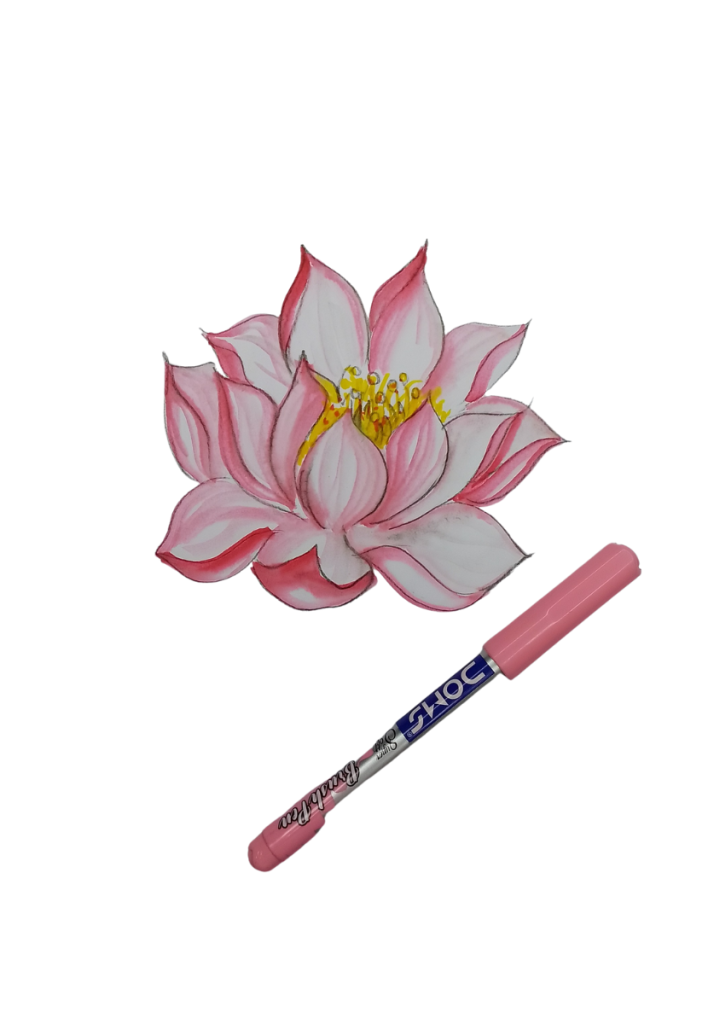
Step-by-Step Guide: How to Draw a Lotus Flower
Step 1: Draw the Center Petal
Start in the middle of your page. Draw a tall oval-like shape that has a point at the top and a slightly curved bottom. It should look like a long teardrop or a flame. This will be the center petal of your lotus flower.
Helpful Tip: You can think of it like a tall leaf standing upright. Try to keep the sides even.
Step 2: Add Two Petals on Each Side
Next, draw one petal on each side of the center petal. These petals should be slightly shorter and curve outwards, like arms reaching to the side. Each one should start at the base of the center petal and curve up, meeting at a pointed tip.
Helpful Tip: Make sure both side petals are about the same size and angle to keep the drawing balanced.
Step 3: Add Petals Behind the First Row
Now we will draw a second row of petals peeking out from behind the first three. These petals should be wider and a little shorter than the first ones. Space them out evenly and draw three of them behind the center and side petals.
Helpful Tip: Lightly sketch the outlines first so you can adjust their position before darkening the lines.
Step 4: Draw Larger Petals in the Background
Draw another layer of petals in the background to give your lotus flower more depth. These should be the largest petals so far, and they will curve outward and upward behind all the other petals. Draw about three of these to complete the flower’s full bloom.
Helpful Tip: These petals should extend out to the sides and slightly upward, helping the flower look open and full.
Step 5: Create the Base of the Flower
Underneath the flower, draw a small curved line that connects the bottom tips of the petals. This will form the base where all the petals seem to grow from. Think of it as a small bowl or cup supporting the flower.
Helpful Tip: Make this curve smooth and shallow to gently hold the petals above it.
Step 6: Draw the Stem
From the bottom of the flower’s base, draw two vertical lines going downward to make the stem. You can keep it straight or add a gentle curve to give it a more natural look. Connect the two lines at the bottom.
Helpful Tip: Keep the stem thick enough so it looks strong enough to hold the flower, but not too wide.
Step 7: Add Large Lotus Leaves
Lotus flowers are known for their wide, round leaves. On either side of the stem, draw two large oval shapes that sit flat and wide. These leaves should look like pancakes or lily pads and can be drawn lying on the water’s surface.
Helpful Tip: The leaves do not have to be perfect ovals. Add gentle curves to make them look more natural.
Step 8: Add Petal Details
Inside each petal, lightly draw a few curved lines starting from the base and moving upward toward the tip. These lines follow the shape of the petal and give it a more realistic and three-dimensional look.
Helpful Tip: Don’t press too hard. These lines should be soft and not too dark
Step 9: Trace Over Your Drawing
Once you are satisfied with your sketch, use a black marker, pen, or dark pencil to trace over the final lines of your drawing. This will make the drawing stand out and look clean.
Helpful Tip: Move your hand slowly and steadily when tracing so that your lines are smooth and accurate.
Step 10: Erase Extra Pencil Lines
After tracing, gently erase all the pencil lines that are still visible underneath the ink. This will make your drawing neat and bold, like a professional illustration.
Helpful Tip: Use a soft eraser to avoid tearing the paper or smudging the ink.
Final Touches
Your lotus flower is now fully drawn and outlined! At this stage, take a final look and see if you want to add any small decorations—such as water ripples, a dragonfly, or a sun in the background. This is your chance to personalize your artwork.